Dada Part 1
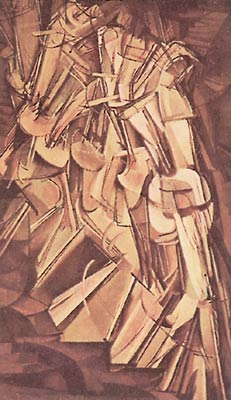
Marcel Duchamp's "Nude Descending a Staircase (No. 2)," painted in 1912 and standing at 146 by 89 cm and on display at the Philadelphia Museum of Art, is an example of the cubistic style that is typical of this artist's oil paintings. Duchamp uses repetition of different elements throughout the painting, unifying it to create a sense of harmony. The repetition of the polygons in both the central figure and the staircase help lead the viewer's eye through the painting, following the figure's path. The use of dark outlines to bring out certain shapes can also be seen throughout the painting. The most obvious of repeated elements is the colour scheme. The artist uses a monochromatic brown palette, which helps evoke a sense of natural well-being and practicality. The loose, yet controlled linear qualities combined with thin dry brushstrokes add to the feeling of movement within the piece. The artist also indicates motion with quick, dry curves creating almost a tumbling effect in the painting. The intensity of the highlights against the dark shades in the background makes the central figure almost appear to be illuminated before its dark surroundings. The overlapping of the figure against the staircase create a sense of depth and perspective giving the subject a three-dimensional look. The artist also used the angles and contour lines to draw the viewer's eye into a central focus by creating a series of points that end in the lower right-hand corner of the painting. By making the fore-most figure the most distinct and tinted, Duchamp creates a sense of the passage of time. The painting seems to have taken place over an extended interlude. The figure almost appears to be moving in slow motion. The density of the outlines in the upper half of the painting draws the viewer's eyes down to the figure's legs. The creation of a triangle within the painting shows the artist's knowledge and application of compositional elements, but the rejection of realism and the artist's interpretation of time captured in a single frame created something both fresh and unique.
back
part of the feuschia project

|